
The second racket
By Paul Fagan, founder of Squash Dog
Paul Fagan on LinkedIn (opens in a new tab)Two rackets, one game
By the time I arrived home from my first game of squash, I had decided to buy two rackets. This was an ambitious investment for someone who, earlier that day, had been unsure whether he could survive the game, let alone develop a taste for it. But one racket was clearly not enough: I would need one for myself, and another for whoever I could persuade to join me.
My enthusiasm had comfortably overtaken my ability. It would turn out to be a recurring theme.
I had never been particularly sporty at school, and squash had already acquired a fearsome reputation in my teenage imagination, populated by extraordinarily fit people who thought nothing of spending their time in their natural habitat, relentlessly chasing a hot rubber ball around a 10-by-6-metre enclosure. I parked it firmly in the bucket marked “other people’s pursuits”, without imagining for a moment that I would ever play.
One of my good school friends, Karim, occupied the opposite end of the sporting spectrum. He seemed to have a natural gift for virtually any sport he turned his hand to, whether at school, university, or later in life. His occasional assessment of my own athletic contribution was rather more concise: “Are your arms painted on?”
By thirty, I had accumulated little evidence to challenge Karim’s assessment. Having been cajoled into joining a gym by another friend, I climbed onto a cross trainer one afternoon and selected its lowest effort setting: level zero. Two minutes later, I needed to sit down for five minutes to recover. Spending considerably longer recovering from exercise than actually doing it did not bode particularly well for my new gym membership, let alone a future on a squash court.
Years later, my friend Carmine suggested a game of squash, and, fortunately for me, he was very persuasive.
A little friendly persuasion
Carmine and I had become friends after a chance encounter in London. He and his wife, Fleur, had welcomed their first son, Edmund, around the same time as my son, Fede, and our friendship blossomed, helped, perhaps, by what I still regard as a lifesaving Heimlich manoeuvre at a summer barbecue to dislodge a grilled king prawn. It is difficult to remain merely casual acquaintances after that. He had played squash only a handful of times himself, but had already caught the bug and was keen to share it.
When he suggested playing at Bloomsbury Fitness Centre at University College London (opens in a new tab), in central London, I eventually allowed myself to be persuaded. I had played a little tennis at school, which seemed a reasonable enough basis for optimism, provided nobody examined it too closely.
Our early efforts were mostly concentrated on making good contact with the strings, rather than the frame, and keeping the ball in play. We missed plenty of shots, occasionally surprised ourselves with a decent rally, and initially showed each other a generosity that began to evaporate as soon as we discovered the pleasure of putting the ball just out of reach.
Somewhere between the missed shots and the developing competitive streak, I stopped worrying about whether I belonged on a squash court. I was far too preoccupied with the pure enjoyment of it and the adrenaline rush.
The forty minutes flew by, and by the time we had finished, we were already discussing the next game. Before long, we had booked the next session, followed by several more at the Porchester Centre (opens in a new tab) in Bayswater, London, a Grade II* listed leisure centre on Queensway.
Those two rackets were a small but enthusiastic commitment to making sure this continued. If someone was willing to give squash a try, I wanted their lack of equipment to be a problem I could solve immediately. Over the years, that spare racket has passed through the hands of old school friends, people I have met through work, and plenty of others who made the mistake of showing even a passing interest.
Too busy enjoying myself
What surprised me most was how completely squash absorbed me.
Karim and I have remained friends from school into our fifties, and he still gives me a good thrashing on the golf course from time to time. He is rather less inclined to test those supposedly painted-on arms on a squash court these days. Some sporting hierarchies, it seems, are more negotiable than others.
Golf itself consumed a great deal of time without delivering the fitness I wanted. Swimming, the treadmill, and further encounters with the cross trainer often left me calculating how much longer I needed to continue before I could reasonably stop.
Squash left very little room for that sort of negotiation. There was a ball to reach, a shot to choose, and an opponent whose plans rarely aligned with my own. Even when a rally ended, the ball was usually close by, ready to be picked up so we could have another go.
I would finish sweating and knowing I had worked hard, yet still be thinking about a shot I wanted to improve or a rally I wished had lasted longer. My ever-present Apple Watch allows me to (over)obsess about the latest statistics: heart rate, calories burned, and whether my VO₂ max is creeping upwards when I’m off the court. Once I’m playing, though, I am far more interested in whether I can retrieve the next ball and, every now and then, find that ever-elusive winner.
For someone who had struggled to enjoy conventional exercise, this was quite a discovery. I had found something I wanted to make time for, and the effort came along with it.
There was another benefit, too. Whatever had been occupying my mind before a game tended to lose its grip once we started playing. A small black ball can be remarkably demanding of your attention when somebody is doing their best to send it somewhere inconvenient.
For the duration of a rally, I had to be present. The rest of the day could wait, and I began to value that headspace almost as much as the exercise.
Finding my people
As my enthusiasm grew, I joined Paddington Sports Club (opens in a new tab) in Maida Vale, London, and began taking lessons. There was plenty to learn, and I was discovering that wanting to play a particular shot and being able to produce it at will were two quite separate things entirely.
Later, I found another club, this time a subterranean home from home that time seemed to have forgotten, tucked away in a quiet West End mews. The staff made me feel welcome from the beginning, while its unique ambience and patient professional guidance gave me every reason to keep returning, even when my squash was providing rather less encouragement.
After a few months, my sociable Irish side took charge, and I asked reception to connect me with as many people on the squash ladder as they dared. What began as a list of names gradually became regular games, familiar faces, and friendships. There was always someone new to play, something to learn, and another reason to put a game in the diary.
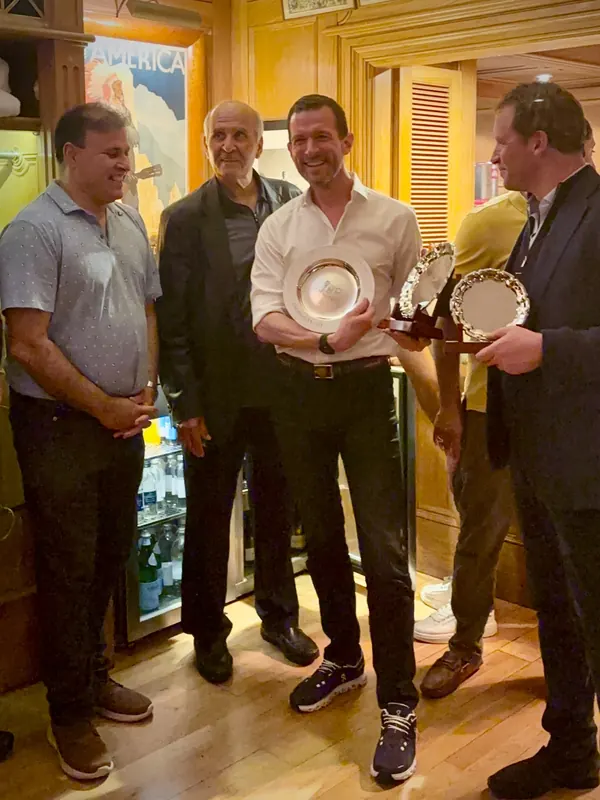
The club competitions added several new dimensions to the experience. Handicap tournaments gave players of different abilities a chance to compete, while plate competitions ensured that losing early did not necessarily mean going home. This struck me as an excellent piece of tournament design.
I also acquired my one and only piece of squash silverware: a plate trophy from the competition for players knocked out in the first round. There are, admittedly, qualifications attached to this sporting triumph, but I see no reason to let them interfere with my enjoyment of it.
Four people, one court
Despite all this growing enthusiasm, I remained firmly unconvinced about doubles.
I was only beginning to feel comfortable sharing a court with one other person. Adding two more seemed likely to multiply the opportunities for getting in the way, embarrassing myself, or accidentally hitting somebody. Whenever the invitation came, I politely declined.
Fortunately, Roderick was persistent. He kept encouraging me until I eventually joined three experienced doubles players, who made me feel welcome immediately and helped me understand what I had been missing.
Our social doubles games had a wonderfully generous atmosphere. Advice could arrive from either side of the court, and an opponent was just as likely as a partner to help me understand a shot. I began experimenting with cross-court drops, lobs, and the little trickle boast, finding a better touch as I learned from the people around me.
Over the next few years, I found a regular group to play with, and doubles became one of the parts of my week I most looked forward to. Somewhere along the way, I also became the person organising friendly matches, finding a fourth player, and encouraging others to join us. I prefer to call it encouragement, although anyone on the receiving end of several invitations might reasonably describe it as being nagged into submission.
Roderick had created a rather enthusiastic successor. Having once needed considerable persuasion myself, I now regarded somebody else’s reluctance as the beginning of a conversation.
Among our regular group was Russell, a highly respected, longstanding member of the club, exceptionally organised, and a darn good singles and doubles player. He had plenty of opportunity to observe how thoroughly I had embraced doubles, both on court and in my efforts to assemble four people on it.
It was Russell who eventually invited me to join the Bath & Racquets Club (opens in a new tab) squad for the Bath Club Cup, playing veterans’ doubles against other clubs. I like to think that my enthusiasm, an unmistakable passion for the game, and the occasional evidence of developing ability helped make the case. By then, at least, he could be reasonably confident that I would be keen.
Last season, I played my first three matches: away against Cumberland LTC (opens in a new tab) and the Oxford & Cambridge Club (opens in a new tab), and at home against Roehampton (opens in a new tab). Being part of the squad gave me another way to enjoy the game and the pleasure of representing the club that had made me feel so welcome.
The term “vets” refers to our age rather than any qualification to treat animals, although my tendency to race around the court like an overly enthusiastic Jack Russell occasionally blurs the distinction. I mostly play when the better squad players are unavailable, an arrangement with which I am entirely happy. There is plenty of enjoyment to be had as the underdog, particularly when I manage to produce a few unexpected winners and briefly justify my selection.
My fitness has improved enormously since my early thirties. These days, racing around the court for an hour, and often considerably longer, feels like a breeze; persuading three other people to be available at the same time can require rather more stamina.
Something to pass on
When Fede was about three, I began taking him along at weekends, initially to play our own version of squash hockey and, later, for lessons. He has been playing with me ever since, and sharing the game with him has become one of its greatest pleasures.
He has already developed little shots that catch me out, and I suspect it will not be long before I have to work considerably harder to keep up. I look forward to his progress with all the pride of a father and just a little concern for my remaining competitive credibility.
I want his younger brother, Alex, to have the chance to discover what he enjoys about the game, too. More broadly, I would love other children and families to have the opportunities we have had: time together, something new to learn, and the confidence that can grow from finding an activity they enjoy.
At 53, squash has become woven into my life in ways I never anticipated. It has given me friendships, time with my son, and a dependable way to clear my head. In a world that asks us to spend so much time looking at screens, I particularly value those hours spent moving, concentrating, laughing, and being with other people.
This probably explains why I am liable to bring up squash within thirty seconds of meeting someone. I would like to think my enthusiasm is infectious, although I accept that some people might appreciate a slightly longer introductory period.
Like a dog with a bone
Once something has brought this much enjoyment into your life, you start noticing all the people who might enjoy it too.
I think about the person who feels too unfit to begin, because I remember being that person. I think about parents looking for something to share with their children, people who would welcome a little more company, and those who have tried several forms of exercise without finding anything they actually want to keep doing.
I also know how fortunate my family and I have been. We have had access to courts, equipment, coaching, and people who encouraged us. For many others, cost, location, confidence, or accessibility can prevent that first opportunity from arising.
Squash Dog grew from my determination to help more people find their way into the game and experience some of the joy it has brought me. The more I have explored what that could involve, the more convinced I have become that there is worthwhile work to do.
There are so many possible starting points: singles, doubles, Squash 57, a practice wall, or a first attempt in a suitable outdoor space.
I want that invitation to extend to people who might never have imagined there was a place for them on a squash court, including people with disabilities. That means listening to what they would enjoy, understanding what would make it possible, and developing opportunities together, including para squash and wheelchair squash. The ambition is to make the welcome real, with accessible places, thoughtful coaching, and people who are pleased to see you.
Through Let’s Bounce, we are developing ideas for bringing visible, welcoming squash into public spaces, starting in London. I love the possibility that somebody who has never considered playing might stop to watch, become curious, and accept an invitation to try. I know from experience how much can follow from that small beginning.
Making it happen will require persistence: listening to communities, finding suitable places, securing support, and working alongside people with the knowledge and experience to deliver it well. My ambition is to help create opportunities that last, so a first visit can become a regular game, a friendship, a family habit, or something a person looks forward to each week.
I cannot promise that everyone will take to squash as I did, but I would love more people to have the chance to find out. If it brings them even some of the enjoyment, confidence, companionship, and headspace it has brought me, that will be something worth working for.
Carmine’s invitation led me onto a court and, forty minutes later, towards buying a second racket. All these years on, I am still trying to put that spare racket into somebody else’s hand; Squash Dog is my way of taking the invitation further.
See how that invitation is taking shape through Let’s Bounce.